
Dental Bridges in Wayne County, NY
True to their name, dental bridges are prosthetic devices that “bridge” gaps in your mouth created by missing teeth. Rather than continually stifling your smile to hide the gap, visit expert restorative dentist Emmanuel Puddicombe. He will expertly fit you with a dental bridge that fills in for either a missing tooth or several consecutive missing teeth.
Benefits of Dental Bridges
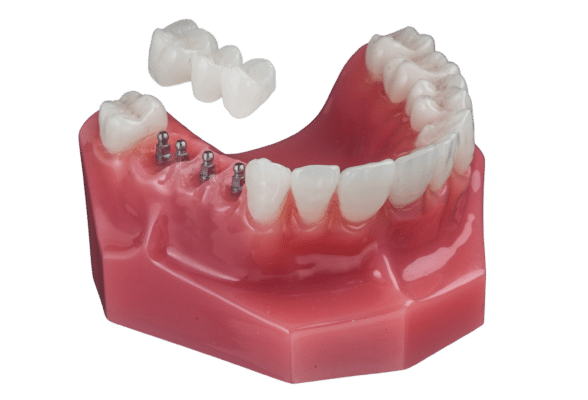 The most obvious benefit of a dental bridge is an aesthetic one. By replacing missing teeth, a bridge can complete your smile. Most people will be unable to detect that your bridge is not a natural part of your mouth.
Function
Beyond the visual aspect, bridges are extremely functional. You will find it is much easier to eat once you have a full set of teeth. It should also help to improve the motion of your bite — many people will adjust their chewing to try to compensate for missing teeth, and that can generate pain and discomfort.
Speech
Your speech is likely to improve with dental bridges, too. Because having missing teeth can make it difficult to speak, you should find it easier (with some amount of practice) to pronounce words once you have a dental bridge to fill in the gap.
Alignment
A bridge also plays a critical role in maintaining the alignment of your teeth. Teeth next to gaps tend to shift out of place. Leaving that space empty jeopardizes the straightness of your teeth. Moreover, people who do not address tooth loss are at risk of facial sagging. To protect your facial structure and the attractiveness of your face, it is advisable to get a bridge or dental implants.
Types of Dental Bridges
At Wayne County Dental Center, Dr. Puddicombe offers all three main types of bridges, each of which is suited for specific situations:
Fixed bridge
Considered the standard bridge, the fixed bridge involves putting crowns on the teeth situated on both sides of the gap. These crowns serve to hold the artificial tooth or teeth in place.
Cantilever bridge
The cantilever bridge is similar to a fixed bridge, except that it uses a single crown on one side of the gap to retain the prosthetic tooth or teeth. The reason for this approach is that sometimes a patient has no remaining teeth on one side of a gap to hold a crown. Aesthetics may also be the motivation for a cantilever bridge, so consider it if you do not want a second crown detracting from your natural teeth.
Maryland-bonded bridge
This type of bridge skips crowns altogether and instead uses metal “wings” that are permanently secured behind the teeth on each gap. It is most often used to replace front teeth because, as the most visible teeth in your mouth, they can be difficult to cover with crowns without them being easily detected.
Dental Bridge Procedure Details
Dr. Puddicombe typically installs dental bridges in two appointments. For your first visit, he will take a mold of your mouth to create a bridge that not only fits perfectly, but also allows for an even bite. He will also shape any teeth that will be receiving crowns. A few weeks later, you will return to Wayne County Dental Center to have this new bridge permanently secured in place. Each of these appointments typically lasts approximately 90 minutes.
Speak to Dr. Puddicombe about Dental Bridges
Dr. Puddicombe would be happy to examine your mouth and determine which type of dental bridge — or perhaps an alternative solution altogether — best fills in any missing teeth. For an appointment, please call (315) 946-4656.